
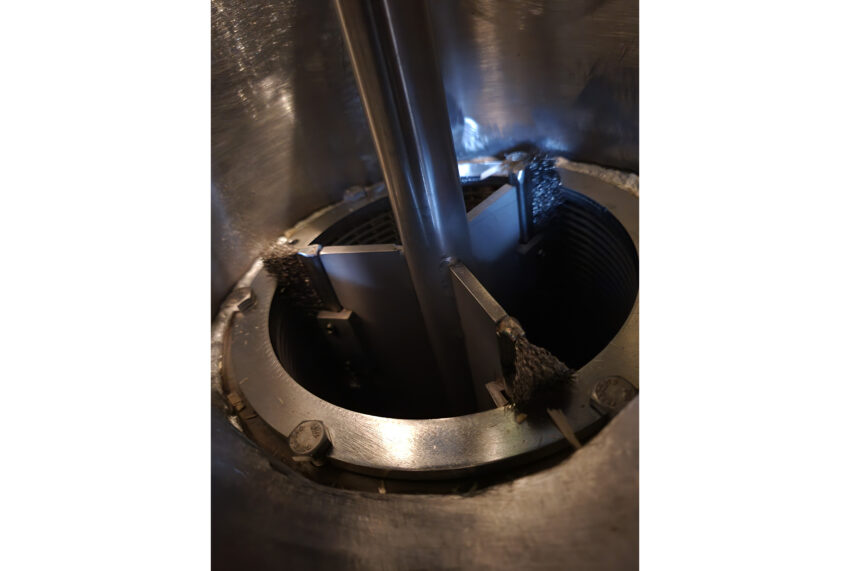
For pulp and paper mill engineers and plant managers, automatic scraper strainers are among the closest solutions to a true “set-and-forget” system, effectively removing both large and fine suspended solids from process water, cooling tower water, wash water, liquids, and slurries.
Industrial strainers help engineers at pulp and paper mills eliminate suspended particles from liquid and slurry streams and are common in many mill processes. These strainers can be used in whitewater processing to remove large clumps of fiber or used as a method to filter black liquor before the stream is sent to the chemical recovery process. Strainers can also be used in other areas such as wastewater treatment, seawater intake, recycled process water, and cooling tower water service.
The basic design represents one of the most efficient and cost-effective industrial self-cleaning strainers available. The motorized unit is engineered for minimal maintenance and operator involvement and can remove solids as small as 75 microns. These strainers allow for continuous, uninterrupted flow, including during blowdown cycles.
Cleaning is performed by a spring-loaded blade and brush system controlled by a fully automatic control unit. The two blades and two brushes rotate at 8 RPM, for a total of 32 passes per minute. The scraper brushes penetrate the wedge-wire slots to dislodge stubborn particulates and adhered solids.
This design enables the scraper strainers to resist clogging and fouling even in mining applications with large debris and high solids concentrations. It also ensures a complete cleaning and is very effective against organic matter biofouling.
However, incorporating minor customizations or application-specific modifications can further optimize the automatic scraper strainer’s performance and suitability for a given pulp and paper application, according to Robert Presser, President of Acme Engineering Products, Inc., a North American manufacturer of industrial self-cleaning strainers.
Choose the Screen Best Suited to the Application
Reverse formed wedge wire screens are the most common screen type used due to their strength, durability and resistance to deformation resulting from high differential pressures. The smooth continuous slot profile minimizes particle wedging and facilitates the use of automated brush cleaning systems.
Add a Macerator to Break Up Large Solids
For applications with high solids loading that are prone to clogging, a macerator can be installed upstream of the automated scraper strainer. This solution accommodates heavy solids loading while ensuring uninterrupted flow and dependable, clog-free performance.
Specify Fiber-Reinforced Plastic (FRP) Construction
When the chemical properties and temperature of the process fluid raise concerns about material compatibility, automated scraper strainers are available in other materials such as Monel, D2205, SD2507, and even Fiber-Reinforced Plastic (FRP). The internal mechanism and wetted components can be manufactured from super duplex or similar high-performance steels.
Pulp and paper mill process fluids are variable in pH levels, temperatures, solid contents, chemical compositions, including white liquor, green liquor, black liquor, bleach plant filtrate, chlorine dioxide, sodium hypochlorite, sodium chlorate, caustic, sulfuric acid and wastewater. The variability of these process conditions makes material selection critical for strainers used in chemical recovery, bleach plant wastewater treatment and process water reuse systems.
For these reasons, duplex or super duplex stainless-steel construction is used to resist corrosion, but at considerable cost. However, a much more cost-effective option is to utilize Fiber-Reinforced Plastic (FRP) strainers that are specifically designed to be resistant to corrosive environments at a fraction of the cost.
For pulp and paper mills, automatic scraper strainers are a more stable answer to solids separation in applications where conventional screens struggle with heavy loading, changing flow conditions, or persistent fouling. Continuous self-cleaning reduces the need for manual intervention, helping mills avoid unnecessary downtime and maintenance.
For more info, visit Acme Engineering Prod. Inc. at acmeprod.com; phone Philippe Ellison, Project Manager at: +1-518-236-5659; email phil@acmeprod.com. In Canada phone: +1-514-342-5656.