
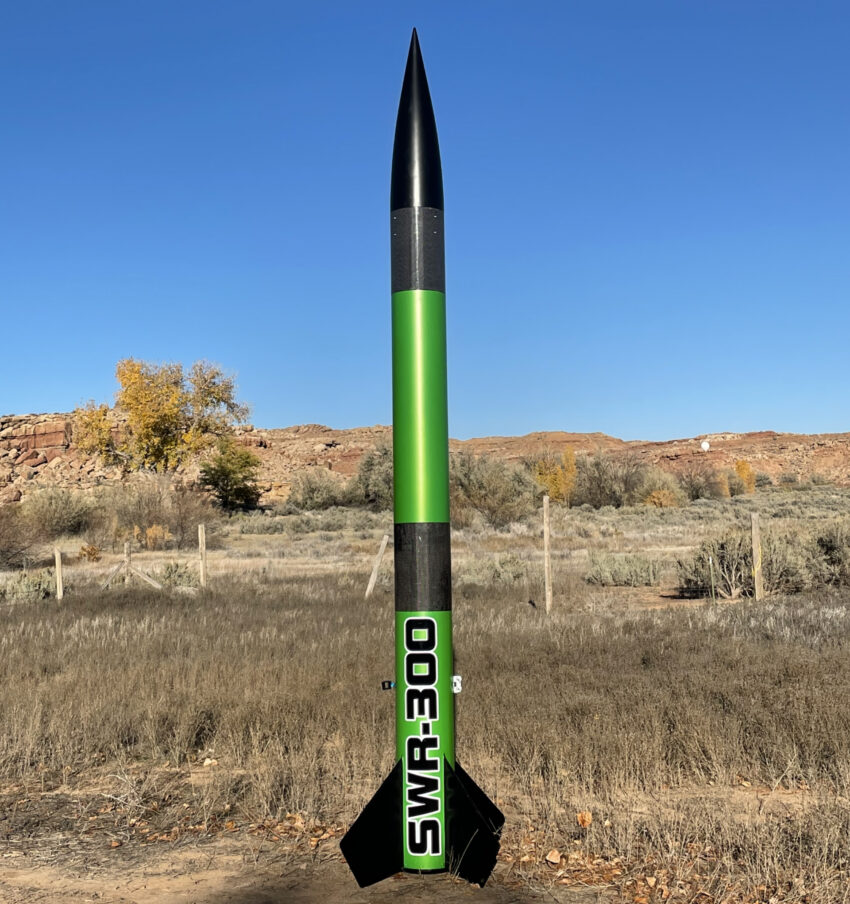
Before a high-power model rocket can climb hundreds or even thousands of feet into the air, it first must travel straight along an aluminum launch rail until it is moving fast enough to continue safely on its own. To keep the rocket aligned during initial acceleration, small plastic rail buttons attached to the side of the rocket slide through a T-shaped groove in the launch rail.
Although rail buttons are relatively simple plastic components, they perform an essential function on every high-power rocket. The buttons guide the rocket along the launch rail during liftoff, making them a required component for every high-power rocket kit.
Instead of continuing to purchase rail buttons from an outside supplier, LOC Precision decided to manufacture the components in-house. The company installed a benchtop plastic injection molding machine from APSX Inc., a U.S.-based manufacturer of compact injection molding equipment designed for prototyping as well as low- to mid-volume production.
“I know the cost of the plastic parts, and even after I pay someone a good hourly wage, I’m still getting them for half the cost,” says David Barber, co-owner of LOC Precision. Based in Plymouth, Wisconsin, LOC Precision manufactures mid and high-power model rocket kits, airframes, nose cones, fins, recovery systems, motor mounts, and other related components.
For a manufacturer that does not require tens of thousands of plastic parts at a time, this is where benchtop plastic injection molding fits particularly well. The equipment provides many of the process capabilities of conventional injection molding, but without requiring the capital, floor space, utility infrastructure, and production volume associated with a complete industrial system.
Barber began searching for a smaller plastic injection molding machine to make these parts around 2017.
The original APSX-PIM fit that requirement and LOC Precision operated the first-generation machine for approximately six years. They then upgraded to the current PIM V3. The APSX machine is approximately 43 inches long, 10 inches wide, and 15 inches high, so it can be installed on a workbench or shop table. It operates on standard wall power and does not require a water-coolant system.
The current PIM V3 is automatic and incorporates electronic temperature control, adjustable injection speed, cycle delay control, precision sensors, a touchscreen interface, and an injection performance chart that displays pressure and volume over time.
Although smaller than conventional equipment, the PIM processes production-grade thermoplastics using aluminum molds manufactured through standard CNC milling. Depending on the application and melt-flow requirements, the machine can process materials including polypropylene, polyethylene, nylon, polycarbonate, acetal, ABS, and various blends.
With six buttons produced during each cycle, even an intermittent production schedule provides LOC Precision with a substantial quantity of parts.
For LOC Precision, the benchtop PIM machine from APSX meets their needs. The company can manufacture a production-grade plastic component in-house, in the quantities required, using an operator who can run the equipment periodically rather than staffing a full injection molding department.
For more information, contact APSX at phone (513) 716-5992, email info@apsx.com, or visit the web site at www.apsx.com. The company is located at 11121 Kenwood Rd. Blue Ash, OH 45242 USA.