
In food processing, high output electrode boilers are used in large plants that require centralized steam or hot-water generation for continuous production. These industrial-scale, high-voltage systems are designed to replace or supplement fossil-fired boiler plants, with outputs reaching the tens of megawatts, configurations that can either be horizontal or vertical, and the ability to produce steam or hot water at industrial pressures. This places them in applications such as dairies, cheese plants, beverage plants, bakeries, and other large food manufacturing operations with major thermal loads.
Their role is to support the plant utilities and process systems that depend on reliable, high-volume thermal energy. For example, in dairy and cheese production, steam and hot water are used for pasteurization, evaporation, drying, clean-in-place systems, sterilization, and plant sanitation. Across food and beverage processing, centralized boiler systems support heating, cleaning, and hygienic production at scale.
Now, modern high-output electrode boilers are redefining how food processors generate steam and hot water. Designed to operate using high-voltage electricity, today’s systems can deliver output capacities of up to 68 MW and steam pressures reaching 39 barg, placing them firmly in the range traditionally occupied by large fossil-fired boilers.
As demand for electrification increases, however, the technology itself is no longer the primary challenge. Instead, attention is shifting toward how these systems are delivered, integrated, and operated. It is increasingly uncommon for electrode boilers to be purchased as standalone pieces of equipment. Instead, projects are typically executed by third-party contractors responsible for full system integration, reflecting the growing complexity of modern boiler installations.
In many cases, an EPC contractor is appointed to oversee the full scope of work, covering engineering, procurement, and construction. Certain elements, such as process design and the development of building layout and architectural concepts, are handled internally, while the remaining work is performed by specialized subcontractors for piping installation, electrical work, and structural fabrication.
Today, that model is increasingly being replaced by single-source providers that perform all the work in-house, delivering fully integrated turnkey solutions. These offerings include the boiler along with all ancillary equipment necessary for installation and may be constructed directly at the site or delivered as prefabricated units for rapid assembly.
These modular designs can reduce project time from months to just a few weeks while also reducing overall costs. By limiting on-site work, they avoid the complexity and expense of installing equipment in existing spaces crowded with piping and steel structures.
“Designing and building a new boiler house off-site allows the work to be completed more efficiently,” says Juha Mäntynen, Chief Executive Officer of CT Industrial Oy (CTI), a CleanTech provider specializing in turnkey, zero-emission, high-efficiency energy systems, including high-voltage electrode boilers.
“All the steel structures for the building, concrete work, pipe assembly, electricity, and control systems—everything is included,” adds Mäntynen.
Turnkey delivery allows customers to take a largely hands-off approach to boiler upgrades, avoiding the complexity and coordination burden typically associated with large infrastructure projects.
For the electrode boilers, CTI partners with North America-based Acme Engineering, a manufacturer of industrial and commercial boilers, to provide high-voltage electrode boilers to the European market.
The electrode boilers are offered in horizontal configurations with capacities typically reaching approximately 10 to 12 megawatts. When higher output is required, a vertical configuration becomes necessary, which directly affects overall unit height. Horizontal models provide a compact profile, generally limited to about 3.5 meters in height, whereas vertical models commonly range from six to eight meters tall.
A Modular Approach
A prefabricated boiler house provides significantly greater flexibility and efficiency. Full control over the layout enables the system to be optimized from the outset, including the strategic use of modularization and prefabrication to reduce site work, improve quality, and streamline installation.
In many cases, the complete hot water or steam boiler system can be assembled in CTI’s facility as a single module similar in size to a shipping container. Factory-built modules reduce overall cost, require less on-site space, and significantly simplify installation. All piping connections, alignment verification, and functional testing are fully completed before the unit is transported.
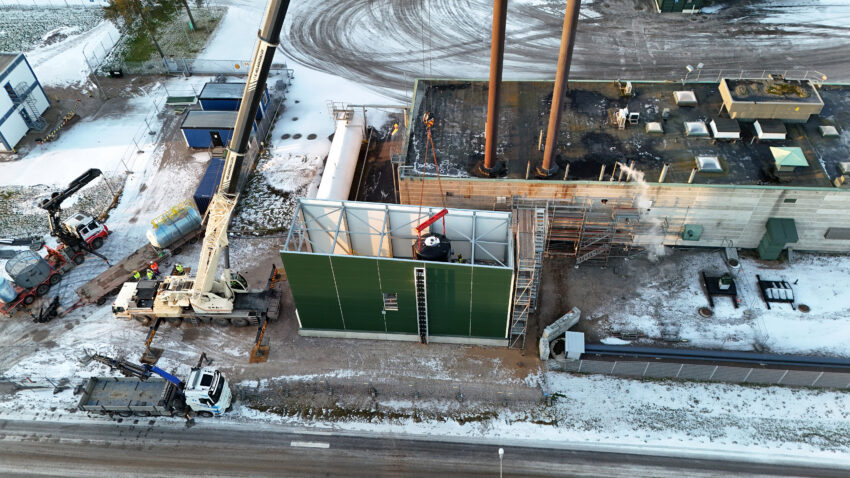
In another example involving a large cheese manufacturing facility, the existing boiler room had no available space for the new equipment. As a result, a boiler building was constructed next to the original. The existing and new systems were then connected by a dedicated piping run to balance and operate both as a single plant.
For more info, contact:
Robert Presser at Acme Engineering at e-mail: rpresser@acmeprod.com, phone: +1 (518) 236-5659, or web: https://acmeprod.com/high-voltage-electrode-steam-boiler/.
Juha Mäntynen at CT Industrial Oy at email: juha.mantynen@cti.fi, phone: +358 50 440 3885, or web: www.cti.fi.