
For municipal sewer departments, effective line cleaning depends on more than powerful jetter trucks and high-performance nozzles. Operators must balance nozzle selection, water flow, pressure, truck RPMs, hose travel speed and actual pipe conditions to find the operating “sweet spot.”
“The goal is to help operators understand what the pipe is telling them, so they can lower the RPMs, control the flow and clean the line in one pass instead of forcing the truck to do all the work,” says Dan Story, Application Specialist at KEG Technologies.
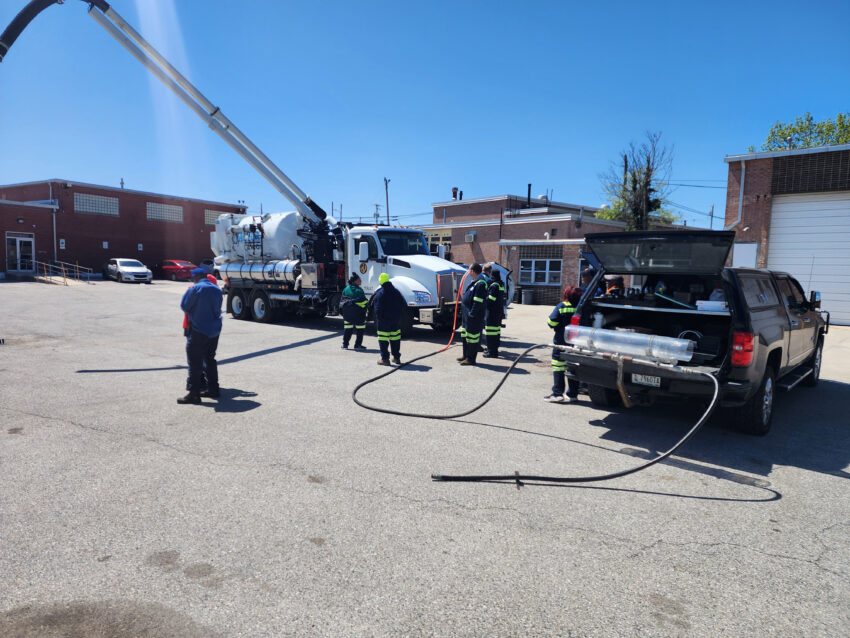
Story demonstrated this approach during field training with the City of Pueblo, Colorado. The crews were initially unsure whether their nozzle was working as expected. The issue, Story found, was not the nozzle itself. The operating settings and cleaning technique needed to match the equipment and conditions inside the pipe.
During one difficult cleaning exercise, the crew limited operating pressure to approximately 1,200 psi, controlled flow at about 35 to 40 gallons per minute and carefully adjusted nozzle speed. The line was completed in one pass. Story notes that an 8-, 10- or 12-inch sewer pipe generally requires no more than 40 gallons per minute.
Because operators cannot directly see underground conditions, Story teaches them to watch the water and debris returning at the downstream manhole. A heavy volume of material signals the operator to slow the nozzle, while changes in water color may reveal a low section of pipe containing stagnant water and debris.
Operators should also clean while advancing rather than sending the nozzle rapidly upstream and attempting to remove everything on the return. Moving at a controlled pace loosens material gradually, allowing the existing flow to carry debris downstream. The return trip can then serve as a final rinse.
To help crews identify efficient settings more quickly, Story provides a pressure-and-flow spreadsheet that correlates nozzle jetting, operating pressure and expected water flow. The chart lets operators select a nozzle configuration, estimate its water delivery at different pressures and compare that information with pipe diameter and field conditions. It can be used with nozzles from virtually any manufacturer when the jet configuration is known.
The spreadsheet provides an informed starting point, but operators must still read the returning water and adjust. Combining the chart with field instruction helps crews reduce repeat passes, conserve water, avoid unnecessary truck wear, and lower the risk of service disruptions during routine sewer maintenance.
For more information, call (866) 595-0515; fax (866) 595-0517; or visit KEG Technologies online at https://kegnozzles.com/.