
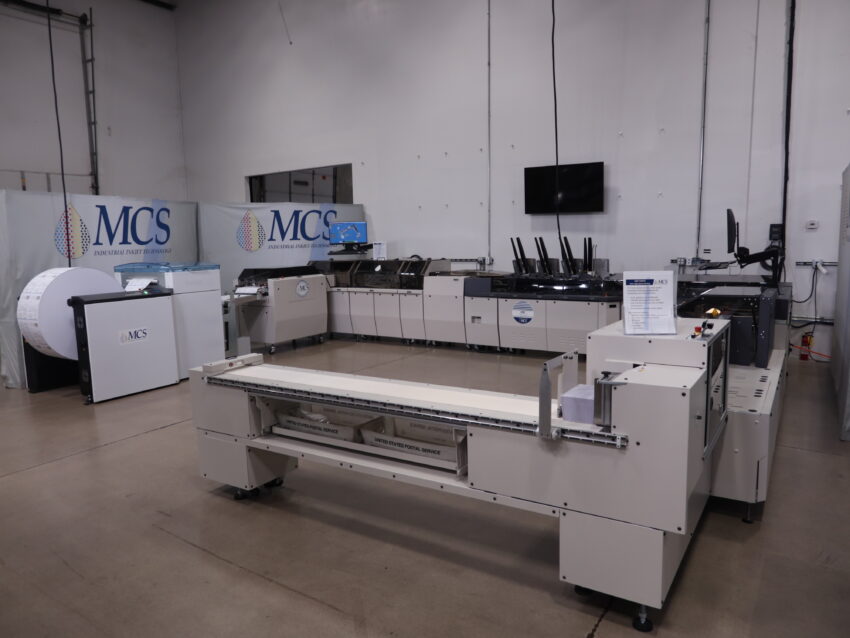
As production inkjet increases upstream capacity, inserting, verification, material handling and job changeovers can become the new production bottleneck. The key is determining net production capacity, not simply comparing rated machine speeds.
This is particularly important as mail manufacturers invest in finishing automation to support greater volumes, shorter runs and more complicated jobs. The question is no longer simply, “How fast can the inserter run?” A better question is: how many good, verified, properly finished mailpieces can the entire operation produce during an actual shift?
Rated Speed Is Not Net Capacity
According to David Loos of MCS Inc., rated machine speed is useful as a reference point, but it can also be deceptive when used to calculate production capacity. MCS designs, manufactures, sells, and supports industrial inkjet imaging, tracking, and inserting systems and solutions for the mail manufacturing industry.
MCS’ own production estimates illustrate the difference. Its EPIC inserter has a highest cycle speed of 24,000 per hour. However, for a #10 envelope with one insert, MCS estimates real-world production at over 19,000 pieces per hour. With six inserts, estimated production drops to up to 9,600 pieces per hour.
“If you look at rated speed, you might say the capacity is 24,000 an hour. But the real capacity depends on the job and how much of the shift the inserter is running,” explains Loos. “For this reason, mail manufacturers should calculate net throughput, which is the number of acceptable finished pieces produced during the total scheduled production period.”
The Whole Line Has to Keep Up
“You can have the inserter running exactly the way you want, but if employees can’t remove and sort the trays fast enough, you just moved the bottleneck,” says Loos. “The same thing can happen with verification or replenishing material. If those steps require too much manual intervention, then that is what limits how much mail you can actually produce.”
Loos concludes by saying that as production inkjet continues to push more work downstream, mail manufacturers need to determine whether finishing capacity has kept pace. For some, that may mean another inserter. For others, the greater opportunity may be automating setup, verification, sorting and material handling so the equipment already installed spends more of the shift doing what it was purchased to do: producing mail.
For more information on MCS and their inkjet printing solutions, visit www.mcspro.com, call 800-728-0154 or email glenn.toole@mcspro.com.