
Industrial strainers are used throughout North America to address a relatively straightforward problem that can become surprisingly complicated in an operating plant: solids and debris can foul, plug, damage or interfere with pumps, heat exchangers, nozzles, valves, meters, and other downstream equipment.
However, the more important issue is not simply whether solids are present. It is what type of solids are present, their quantity, how frequently the loading changes, where the fluid originates, and what happens when the strainer becomes loaded.
These factors can vary dramatically between a refinery on the Gulf Coast, a power facility drawing surface water from the Great Lakes, an irrigation system in the Southwest, a pulp and paper mill in Canada, or an industrial facility increasingly relying on reclaimed water.
For these types of applications, automatic strainers become increasingly attractive when solids loading can change with little warning, manual cleaning will be frequent, personnel are unavailable to continually service the strainer, or significant downstream damage could occur if cleaning is delayed.
Cooling Water
One of the most widespread industrial applications is cooling water. This includes open cooling towers, once-through cooling systems, closed-loop systems supplied by makeup water, heat exchanger circuits, and process cooling systems.
Outside debris can enter the system, while rust, scale and biological material can also develop internally. “The strainer must remove this suspended material before it can contribute to plugging, fouling, and wear,” says Robert Presser, president of Acme Engineering.
Surface Water Creates a Different Set of Problems
For facilities pulling cooling or process water from a river, lake or reservoir, heavy rain can increase sediment and seasonal growth can bring algae and vegetation.
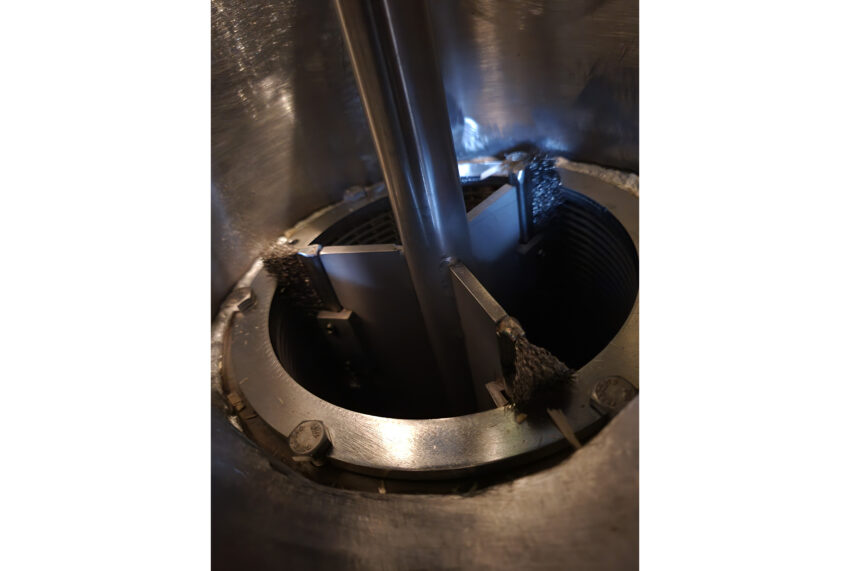
The strainer may have to contend with solids from relatively fine suspended material to much larger debris. Acme Engineering’s automatic scraper strainer can handle both ends of this range, removing large debris as well as much smaller suspended solids in a single motorized unit. The blade and brushes scrape the screen clean, while small brush filaments get into the wedge-wire slots and dislodge resistant particulates.
For more information, visit Acme Engineering Prod. Inc. at acmeprod.com; phone Philippe Ellison, Project Manager at: +1-518-236-5659; email phil@acmeprod.com; mail Acme at Trimex Building, Route 11, POB 460 PMB 10, Mooers, New York 12958. In Canada phone: +1-514-342-5656; mail them at 5540 Rue Paré, Mont-Royal, QC H4P 2M1.