
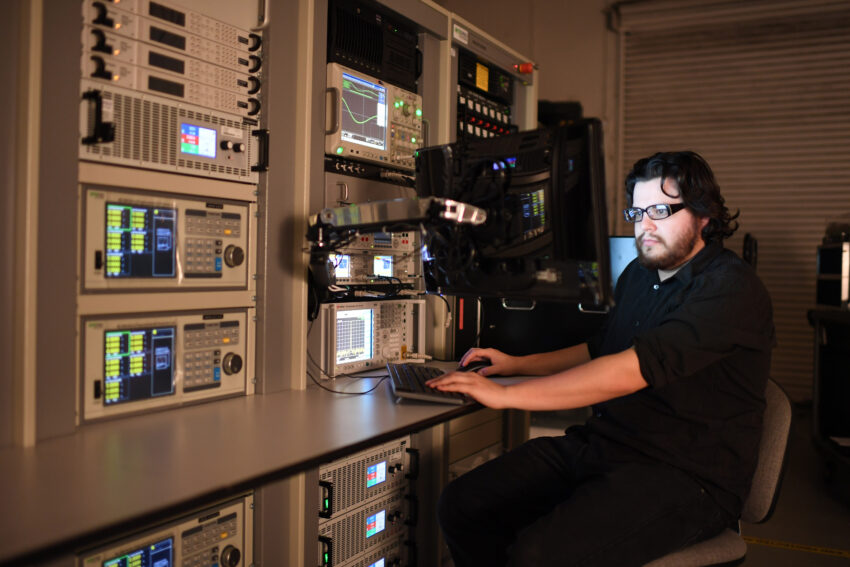
Automated Test Systems (ATS) serve the critical purpose of ensuring that electronic devices operate according to specifications in the field, thereby averting the introduction of flawed products to the market.
For this reason, the aerospace and defense sectors make substantial investments in ATE due to the criticality of lifesaving electronics utilized in military equipment such as aircraft, naval vessels, and ground vehicles, as well as in various systems like weapons, radar, and wireless communication.
This high-stakes environment demands not only precision but also long-term flexibility—making hardware independence a key design priority. By decoupling test software from specific instruments or platforms, engineers can extend system life, streamline maintenance, and adapt quickly to evolving technology without costly overhauls.
“Hardware independence is important for several reasons. Although the test equipment hardware requires a significant investment of hundreds of thousands to 3-4 million dollars or more, the writing of test programs costs multitudes more,” says Andrew Engler of Intepro Systems. Founded in 1981, Intepro has supplied Automated Test Equipment (ATE) systems that test power electronics used in various applications.
Although ATE systems can be used for different types of tests in a hardware-independent manner, Engler says Intepro specializes in power electronic testing, which includes testing power converters, inverters, chargers, batteries, adapters, and other power components.
“A typical automated test solution consists of hardware, software, test instruments, signal sources, and test harnesses, probes or handlers,” explains Engler. “However, not all automated test solutions use the same components. The configurations vary widely depending on the device being tested by the customer and the parameters requiring measurement.”
The hardware components are typically consolidated into all-in-one test stations, which vary in size and portability from compact test stations on wheels to large stationary test towers.
Engler describes the software as the “heart” of the ATE station. However, when the test parameters change, or hardware must be replaced, the software must be reprogrammed.
“Many of our customers are project-based,” explains Engler. “So, if they are involved in aerospace testing and they have a multi-year project that gets reassigned, now the test station they have has to change. They can either throw it all away or they can refurbish it and adapt it to the requirements of a new program,” says Engler, adding that if the test requirements change dramatically, entire stations can end up as “500 lb. paperweights collecting dust in a test lab.”
Engler says this contradicts the core objective of ATE, which is to automate and streamline repetitive testing to save time, reduce errors, and provide a repeatable process.
“Even if you are an expert C+ or Python programmer, it is going to take you a lot of time to get through lines and lines of code. We simplify that process and cut the development time in half, or more,” adds Engler.
The ability to interchange hardware without significant software reprogramming offers substantial advantages to sectors bound by stringent regulations and federally mandated approvals, including aerospace, defense, and medical equipment manufacturing. Once test programs and procedures are established and approved, obtaining a re-approval after programming changes can be expensive. Tools such as Intepro’s PowerStar, a hardware-independent test software platform, enable engineers to document their progress, thereby decreasing the time required to certify test programs.
According to Engler, PowerStar provides hundreds of fill-in-the-blank test routines that provide a range of control, from single instrument functional control to full test procedures with easy-to-use parameter entries. Engineers can customize their programs, without having to write code or assemble graphical components.
Even in the absence of explicit regulations, any company manufacturing products for critical applications may be legally liable if the product malfunctions. This underscores the hidden costs associated with inadequate testing.
Today, more advanced software options can deliver unprecedented levels of flexibility for ATE engineers and operators, simplifying intricate testing procedures and saving time and resources. This only strengthens the potential of automated testing as a valuable data acquisition and diagnostic tool for testing electronics across industries like defense, aerospace, automotive, and industrial automation.
For more information, visit www.inteprosystems.com, call (714) 953-2686 or email sales@inteproate.com.