
Food plant engineers are responsible for ensuring that production systems run safely, efficiently, and in full compliance with hygiene and food safety standards. They oversee multiple processes that depend on reliable, contaminant-free water.
Within the industry, food plant engineers are often involved in specifying strainers, particularly in applications that require bid specs or system-level design decisions. In this endeavor, automatic scraper strainers offer numerous advantages over traditional choices such as backwash filters and basket strainers.
Philippe Ellison, Project Manager, Acme Engineering Products, a North American manufacturer of industrial self-cleaning strainers, offers the following guide to help food plant engineers understand the advantages of scraper strainers versus traditional filters.
Manual Basket Strainers
In water filtration applications, basket strainers are used to remove coarse materials such as leaves, sand, rust, scale, and other solids in the water. In continuous flow processes, duplex basket strainers are often installed. When one chamber needs cleaning, the flow is seamlessly diverted to the alternate chamber, enabling the removal and cleaning of the first basket.
However, cleaning is a messy, laborious process that involves equalizing pressure between the baskets, diverting flow to the off-line chamber, opening the cover, manually removing the clogged basket, and cleaning it before refitting the basket, ensuring the seal, and tightening the fasteners.
Backwash Systems
Food plant engineers are generally most familiar with backwash systems, which often leads to their default specification. Backwash filters are designed to operate continuously with minimal manual intervention by automatically cleaning themselves through a backwashing process.
Unfortunately, backwash filters rely on a substantial amount of flow and constant pressure, which can compromise reliability if not always available. Additionally, conventional backwash units are not designed to effectively remove larger or irregularly shaped solids. The problem is that the backwash arm must be quite close to the screen to function properly and that prevents the passing of larger particles.
Automatic Scraper Strainers
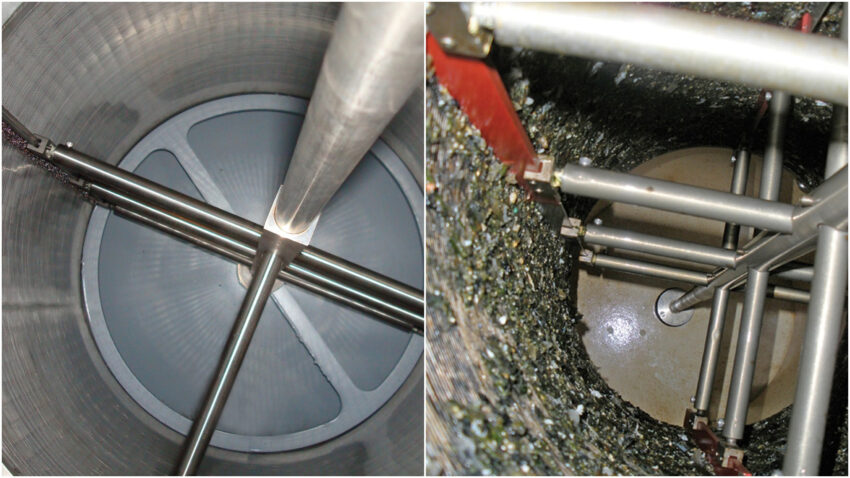
Unlike backwash strainers, automatic scraper strainers do not rely on a pressurized backwash to remove solids from the screen. Instead, blades and brushes provide more reliable cleaning under varying conditions.
The automatic scraper strainer from Acme Engineering is a motorized unit that has four blades/brushes that rotate at 8 RPM, resulting in a cleaning rate of 32 strokes per minute. The scraper brushes get into wedge-wire slots and dislodge resistant particulates and solids. This approach enables the scraper strainers to resist clogging and fouling when faced with large solids and high solids concentration.
Scraper strainers allow the solids to accumulate at the bottom of the vessel, where the blowdown valve will open periodically to clear them out. Blowdown occurs only at the end of the intermittent scraping cycle when a valve is opened for a few seconds to remove solids from the collector area. Liquid loss is well below 1% of total flow.
If additional pressure is required to clean the screen, Acme Engineering can add an inexpensive trash pump to the blowdown line to assist in removing the solids from the strainer sump. For applications with high solids loading that are prone to clogging, a macerator can be installed upstream of the automated scraper strainer to break down large solids into smaller fragments.
Food plant engineers face increasing pressure to deliver systems that are not only high-performing and cost-effective but also reliable and low maintenance. The adoption of advanced scraper strainer technology represents a significant opportunity to meet these demands.
For more info, visit Acme Engineering Prod. Inc. at acmeprod.com; phone Philippe Ellison, Project Manager at: +1-518-236-5659; email phil@acmeprod.com/