
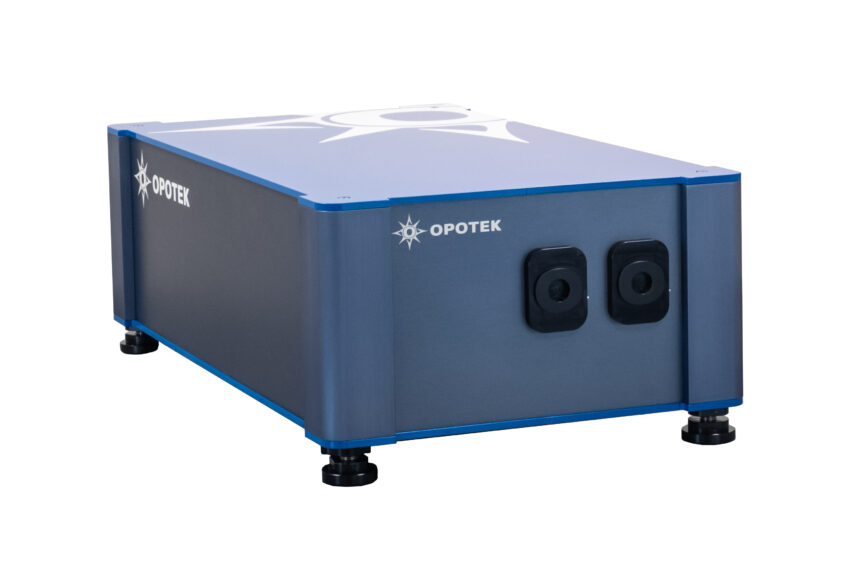
Fast-firing tunable lasers are transforming next generation imaging technologies by enabling faster data acquisition and higher resolution.
Since the advent of laser-based imaging techniques in the early 2000s, image acquisition has faced a fundamental challenge: the imaging speed and signal averaging was directly tied to the firing rate of the laser. Because a minimum of one laser pulse generates a single data point, traditional flashlamp based lasers operating at relatively low repetition rates were constrained in their ability to capture fine spatial or temporal detail quickly.
For applications requiring real-time analysis or high-resolution mapping, these limitations often reduced the practicality of otherwise powerful imaging technologies.
Fortunately, the emergence of high-repetition-rate lasers based on diode-pumped solid state (DPSS) are resolving these long-standing barriers.
OPOTEK recently introduced a new family of DPSS OPO lasers that fire at five to ten times the speed of its traditional offerings, enabling much faster operation. The Opolucis C, for example, has a repetition rate of 100 Hz and peak OPO energy of up to 45 mJ per pulse.
By dramatically increasing the number of pulses per second, systems can sample and process data much faster, dramatically improving both resolution and throughput.
“Similar to how pixel count defines resolution in digital photography, the number of fine laser spots analyzed increases the quality of the image for certain applications. Because each pixel requires at least one laser shot the time required to create a complete image could take hours if the repetition rate is 10 or 20 Hz,” explains Dr. Mark Little, Director of Sales and Support Services at Carlsbad, CA-based OPOTEK.
Potential imaging applications such as in-motion hyperspectral imaging and atomic force microscopy (AFM) infrared spectroscopy. Applications that require the fast and abundant removal of material such as laser-induced breakdown spectroscopy (LIBS) and laser ablation inductively coupled plasma mass spectrometry (LA-ICP-MS) could also benefit from improvements in high-repetition rate lasers.
Another key distinction of the Opolucis and Phocus II Series is that it can provide high pulse energy at high repetition rates. In combination, this means the laser produces a much greater average power, a key measurement of performance.
“Most tunable high-rep-rate systems deliver relatively low pulse energy, which limits its use to low-impact applications. When material needs to be significantly ablated, the new lasers can deliver significant energy output while firing rapidly. This makes the system more viable for applications that involve direct interaction with the material,” says Dr. Little, adding that techniques such as LIBS and LA-ICP-MS that rely on laser ablation to vaporize material so it can be analyzed could benefit.
For more information, call 760-929-0770, e-mail sales@opotek.com, or visit www.opotek.com.