
Textile mill engineers are tasked with maintaining safe, efficient, and continuous operations in environments where precision and process integrity are critical. From managing heat exchangers to overseeing cooling systems and wastewater treatment, they must ensure that every system operates within tight performance and safety parameters.
Water quality directly affects these operations, making advanced filtration essential. Strainers play a key role in separating unwanted suspended solids from liquids and slurries. The strainers may also be used in the treatment of wastewater or removal of debris from process and cooling tower water.
In the textile manufacturing industry, backwash strainers and manual basket strainers are widely accepted technologies and are often the default option during specification. However, conventional strainer designs can present reliability challenges and require frequent maintenance, particularly in applications where large debris or high volumes of suspended solids are present.
In contrast, automatic scraper strainers offer numerous advantages over traditional choices such as backwash filters and basket strainers.
Scraper strainers do not rely on a pressurized backwash to remove solids from the screen. Instead, blades and brushes provide more reliable cleaning under varying conditions.
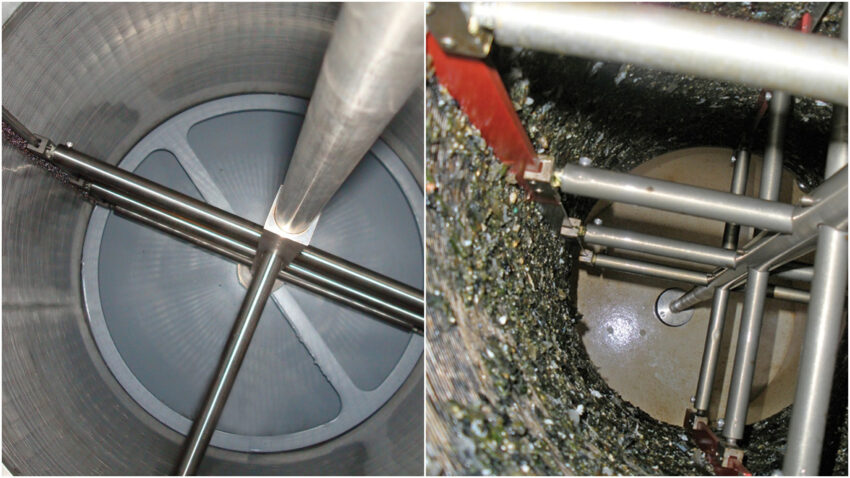
The automatic scraper strainer from Acme Engineering, for example, is a motorized unit designed to continuously remove both large and fine suspended solids. This process is managed by a fully automatic control system.
These scraper strainers are offered with three screen types, selected based on the specific application. Reverse-formed wedge wire screens are the standard choice, valued for their durability and compatibility with brush cleaning systems. For applications requiring finer filtration, multilayer sintered metal mesh screens are recommended. In fibrous processes perforated screens with round holes provide optimal performance.
Four blades/brushes rotate at 8 RPM, resulting in a cleaning rate of 32 strokes per minute. The scraper brushes get into wedge-wire slots and dislodge resistant particulates and solids. This approach enables the scraper strainers to resist clogging and fouling when faced with large solids and high solids concentration. It ensures a complete cleaning and is very effective against organic matter “biofouling.”
For applications with high solids loading that are prone to clogging, a macerator can be installed upstream of the automated scraper strainer to break down large solids into smaller fragments. This combination of proven technologies is already in use for some of the most demanding and debris-laden straining applications.
While standard carbon steel or stainless-steel construction is suitable for typical applications, corrosive environments such as those involving erosive slurries or aggressive chemicals can rapidly degrade conventional equipment. This deterioration can create risks related to safety, quality, and regulatory compliance, as well as cause production downtime due to the need for premature replacement of strainer components.
As engineers become more familiar with scraper technology’s capabilities, supported by application data, installation success stories, and performance metrics, they are more likely to consider it a primary option in system design.
For more info, visit Acme Engineering Prod. Inc. at acmeprod.com; phone Philippe Ellison, Project Manager at: +1-518-236-5659; email phil@acmeprod.com.