
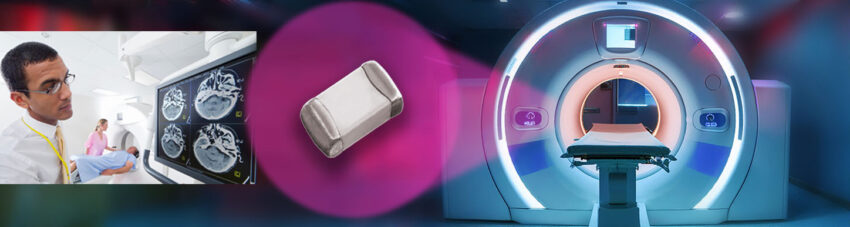
Designing the next generation of wireless wearables, implantables, and real-time external or in-body monitoring devices is a complex challenge that requires highly reliable electronic components that greatly exceed the performance of standard commercial alternatives.
One example of this is found in Magnetic Resonance Imaging (MRI) systems. To produce clean, reliable images, these systems rely on a wide range of passive electronic components that must function in extremely strong magnetic fields and high-frequency RF conditions. These passive elements must be non-magnetic, thermally stable, and engineered to withstand high voltages as well as rapid current transients.
Capacitors, specifically, must demonstrate outstanding reliability because they directly affect the safety, precision, and stability of both the imaging process and the high-power subsystems within the equipment. Even slight electrical variations can compromise safety, distort images, or cause system malfunctions.
To ensure long term reliability, capacitors must tolerate substantial dielectric stress, repeated cycles of charging and discharging, and sustained operation at elevated temperatures without performance degradation.
To meet these requirements in high-power RF sections such as coils, power supplies, and amplifiers, designers frequently use high-Q capacitors.
High-Q capacitors are characterized as having ultra-low equivalent series resistance (ESR). In addition to minimizing energy loss, High Q capacitors reduce thermal noise caused by ESR to assist in maintaining desired signal-to-noise ratios.
To achieve the lowest losses, certified suppliers such as Johanson Technology of Camarillo, Calif. utilize the lowest loss dielectrics, inks and electrode options in their high-Q designs. For more than 60 Years, the company has designed and manufactured multi-layer ceramic capacitors, EMI filters, and other critical components for high reliability applications.
An example is the use of silver and copper electrodes, which outperform nickel in most high-Q applications. Nickel, which is commonly used in the lowest cost capacitors, is a poor conductor known for high loss at RF and microwave frequencies. Unlike silver and copper, nickel also creates a magnetic field that can interfere with devices such as MRI receiver coils.
Historically, Johanson Technology incorporates silver electrodes in its ultra- High Q (lowest ESR loss) offering, the E-Series multilayer RF capacitors in their high-power capacitors.
However, Johanson Technology has two new products that are designed for medical, and more specifically, MRI applications. The High-Q Copper Electrode C-Series Family and the P90 P-Series. The P-Series are designed for high-power RF applications, specifically at the low frequencies commonly used by MRI systems.
For more information, contact Johanson Dielectrics at (805) 389-1166, visit web site: https://www.johansontechnology.com/ppr/medical-innovations/ or e-mail: kvilla@johansontechnology.com. The company is located at 4001 Calle Tecate, Camarillo, CA 93012.