
New advances in laser technology are redefining the operational limits of nanosecond transient absorption spectroscopy (TAS). In particular, the emergence of tunable, high repetition rate lasers that dramatically increase pulse delivery frequency while maintaining ultrafast temporal resolution.
At high repetition rates, these systems increase the amount of data collected per unit time, which reduces the effect of random noise on the measured signals and improves detection of weak transient components. The result is a more complete study of the kinetics of the system and a better understanding of the dynamic processes that occur.
Until recently, however, most tunable lasers have been limited to an operating repetition rate of 10-20 Hz. Exceeding this threshold requires a new generation of diode-pumped solid-state (DPSS) lasers capable of operating at 100 Hz or higher.
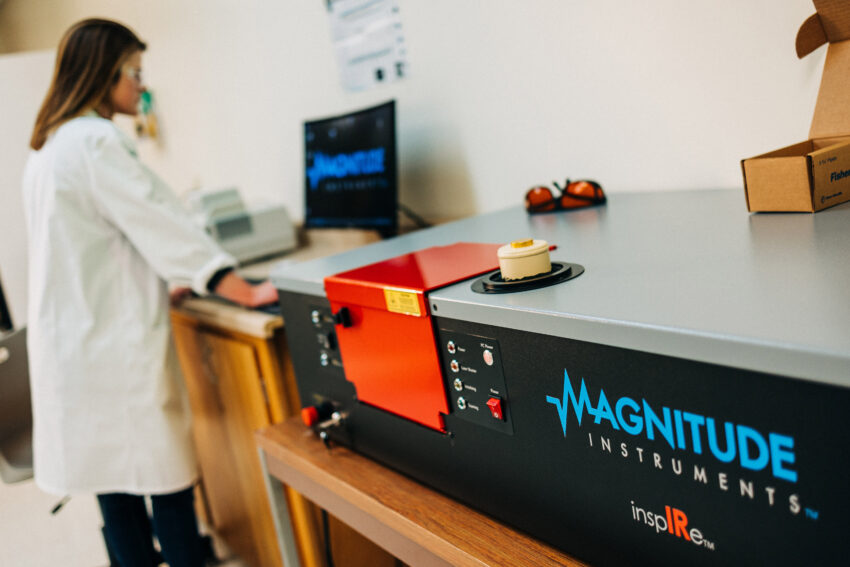
“Firing a tunable laser at a hundred hertz is significant because the spectrometer can collect data much faster. Everything else being equal, if I am collecting data at a hundred hertz versus 10 hertz, I am getting my data 10 times faster,” says Eric Kennehan, Ph.D., Co-founder & CEO of Magnitude Instruments. Based in State College, Pennsylvania, the company offers multiple product lines of fully integrated, benchtop nanosecond transient absorption spectrometers designed for advanced time-resolved spectroscopy applications.
According to Kennehan, Magnitude Instruments was recently approached by a researcher at a leading university seeking information about the company’s benchtop systems. A primary requirement was the integration of an optical parametric oscillators (OPO) – a tunable laser – capable of operating at high repetition rates to meet the demands of the intended applications.
For most applications, a fixed wavelength Nd:YAG laser capable of generating excitation wavelengths of 1064, 532, 355, and 266 nm is included in nanosecond TAS systems. However, when a project requires wavelength flexibility, Magnitude Instruments integrates an OPO or OPA (optical parametric amplifier) sourced from a qualified supplier.
The ability to vary the wavelength enables researchers to select and activate discrete electronic or vibrational transitions within their samples with a high degree of precision and control. This allows researchers to achieve more detailed and application-specific results from their experiments.
Although several manufacturers offer 100 Hz OPO systems, each presented distinct advantages and trade-offs. Magnitude Instruments ultimately decided to partner on the project with OPOTEK, a leading developer of tunable laser solutions.
Kennehan says OPOTEK has a well-established track record, with many years of experience in the field delivering high-performance OPOs for demanding scientific and industrial applications.
Magnitude Instruments previously collaborated with OPOTEK on multiple installations, including projects that incorporated OPOs operating at 20 Hz. However, OPOTEK recently introduced a new family of DPSS-based OPO lasers, the Opolucis C, that can deliver a repetition rate of 100 Hz and peak OPO energy of up to 45 mJ per pulse.
“After reviewing the specifications of OPOTEK’s high-repetition-rate lasers, they were in that sweet spot of offering the performance parameters that aligned with the customer requirements at a price that allows the customer to invest in both an OPO and the spectrometer,” says Kennehan.
The compact footprint of the Opolucis C was particularly compelling, as reducing overall system size remains a central design objective for Magnitude Instruments.
For more information, call 760-929-0770 or visit www.opotek.com.