
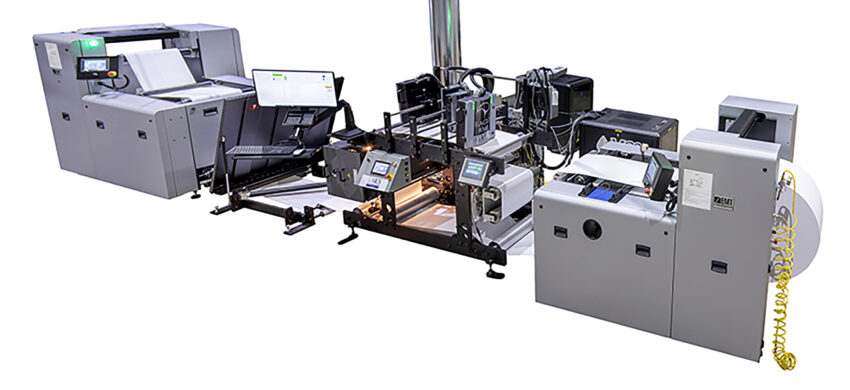
The need for absolute accuracy in mail manufacturing underscores the importance of an integrated system in which every component works together seamlessly to achieve results that are greater than the sum of its parts.
A high-volume personalized mail manufacturing system functions as a coordinated network rather than a standalone machine. Most systems are a combination of technologies from inkjet systems that employ different types of technologies and even inks, to inserters, card attaching systems, and tracking and cameras that verify printed information is correct, and that items are properly matched together. Software often ties the entire process together.
In many cases, however, the individual components that make up a system are supplied by different manufacturers, often located in various regions across the globe. When key technologies are sourced overseas, the primary equipment supplier may lack the in-house engineers or product designers to customize hardware or software, leaving little flexibility for modification or improvement.
This is where there can be significant advantages to working with suppliers that can offer a customized, end-to-end mail manufacturing solution.
“With this approach, organizations gain a cohesive system engineered from the outset for speed, accuracy, and scalability, backed by direct accountability for system performance,” says David Loos of MCS, Inc, a company that designs, manufactures, sells, and supports industrial inkjet imaging, tracking, and inserting systems and solutions for the mail manufacturing industry.
Loos breaks down the component parts of a mass mail manufacturing system and provides examples of how, when integrated cohesively, they can work together to deliver superior results through a more holistic approach.
Inkjet Printing Systems
The foundation of modern mass mail manufacturing is the industrial inkjet system. These are not ordinary printers but highly specialized machines that can produce variable data printing at extremely high speeds. They support hyper-personalization by printing individualized text, graphics, addresses, and even variable barcodes on each piece of mail.
Different printhead technologies—such as piezo and thermal inkjets—can be employed, and inks can range from water-based dyes to UV-curable pigments depending on the substrate. High-end inkjets can run at more than a thousand feet per minute, even when every piece of mail is customized.
In mail manufacturing, the printing and personalization stage often relies on different types of inkjet technology, selected according to the requirements of each job.
Loos says MCS, for example, offers several industrial inkjet systems under different product families, intended for personalization, addressing, page printing, or envelope printing.
The Eagle series is a flagship line: for example, the Eagle 20 Inkjet Printer is positioned by MCS as ideal for high-speed addressing, tag printing, and barcode printing tasks. The Eagle 30 and Eagle 40 models extend the throughput and drop-size options, while the Eagle 8530 / 8540 series target wider media formats (8.5″ width) with 600 dpi print quality at competitive speeds.
In addition, the company offers the Falcon line (which historically has been their HP-based addressing platform) for envelope addressing and versioning tasks. The Osprey systems (e.g. Osprey 26 or Osprey 72) are emphasized in the context of card-attaching lines and high-speed printing in mixed media lines.
For full-color or “process color” printing (i.e. four-color), MCS promotes the new Harrier and Condor as its process-color inkjet line and also Merlin K146c as a cut-sheet process-color press solution.
These inkjet systems often integrate with the system software and workflow tools to handle variable data, job layouts, drop size control, and color versioning.
Inserters
Inserters are machines that automate the process of folding, collating, and placing materials into envelopes. They are indispensable for transactional mail and marketing campaigns where multiple documents, cards, or flyers must be matched correctly with the right recipient envelope.
High-capacity inserters like the FlowMaster can process up to 12,000 envelopes per hour. They may also include verification add-ons to ensure every set of documents is correctly assembled and nothing is missing or mismatched.
There are also optional enhancements for inserters, such as OE (On-Edge) stacker options that allow for increased output stack capacity, automatic offset tray breaks, and labor reduction features.
Card Attaching Systems
When mail pieces require loyalty cards, membership cards, or promotional cards, card attaching systems are employed. These machines can affix single or multiple cards directly onto letters, brochures, or carriers. Some lines are designed with dual-stream functionality, doubling output by attaching two cards simultaneously at speeds of up to 20,000 pieces per hour.
Card attaching line systems integrate with the inkjet personalization and tracking systems to ensure correct matching between the card and its mail carrier.
Tracking and Verification Systems
Accuracy is paramount in mail manufacturing—particularly when handling financial statements, healthcare records, or other sensitive data. To maintain absolute precision, tracking technologies such as the Perfect Track suite monitor each stage of production from start to finish. These systems manage critical functions including match mailing, read-and-print operations, insert verification, and electronic double-detection. They also record detailed production data—operator credentials, machine IDs, piece IDs, and time stamps—and can even capture images of individual mail pieces to verify compliance.
Cameras and Imaging Systems
Cameras act as the first line of defense against production errors, scanning and verifying variable data on every printed piece to ensure accurate personalization. These imaging systems also perform integrity checks, confirming that inserts, cards, and envelopes are properly matched before sealing to maintain complete process accuracy.
Software Integration Platforms
Underlying all the physical machinery is software that orchestrates the workflow. These platforms connect databases of customer information with inkjet systems, inserters, and verification modules. They manage versioning, drive multiple printheads, control personalization logic, and handle error reporting.
For more information on MCS and their inkjet printing solutions, visit www.mcspro.com, call 800-728-0154 or email glenn.toole@mcspro.com.