
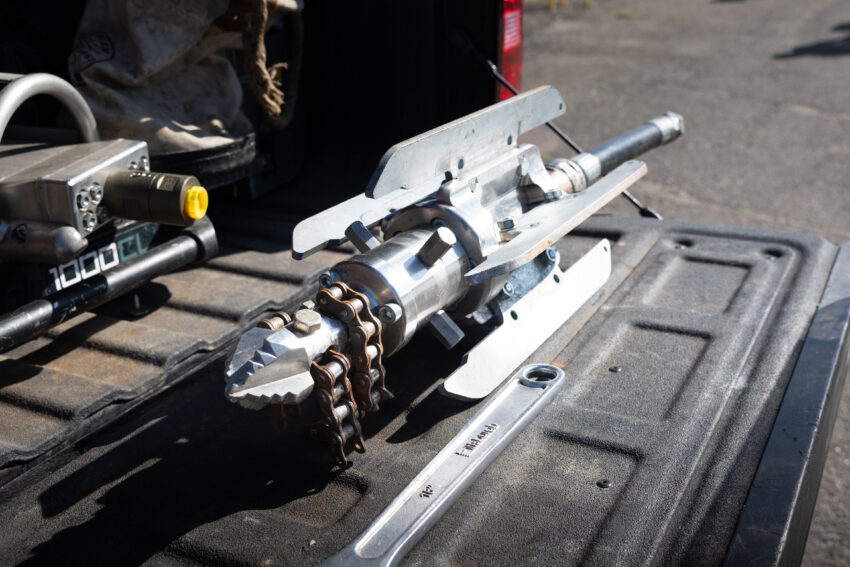
Deep cleaning is necessary before replacing the lining of sewer pipes. High-powered nozzles and chain cutters make pipe cleaning quick and efficient.
Pipe lining has become a go-to solution for renewing aging sewer and storm lines without the disruption of open-cut excavation. By installing a new liner inside an existing pipe, crews can restore structural integrity, seal leaks, and extend service life while keeping streets, sidewalks, and landscapes largely untouched.
But the success of that liner depends on what happens first. Liners are installed by inverting or pulling them into the host pipe and holding them tightly against the pipe wall with air or water pressure, while steam or hot water is used to cure the resin and form a new structural pipe within the existing one.
However, blockages in the pipe formed by tree roots, hardened mineral scale, grease buildup, silt, and debris can interfere with this process. If a liner is installed over these obstructions, it cannot fully contact the host pipe, which can lead to wrinkles, voids, weak spots, or areas where the liner never properly bonds or cures.
Fortunately, the right combination of nozzles and cutters allows crews to remove even the most stubborn buildup, allowing the liner to work properly once it is installed.
“The inside of the pipe must be spotless for the liner to work properly. In industry terms, this condition is described as being ‘gun barrel clean,’” says Dan Story, an experienced trainer and Operations Manager at KEG Technologies, a leading manufacturer of nozzles and chain cutters used to clean sewer and stormwater lines.
To clean a sewer line thoroughly prior to lining, specialized jetting nozzles are operated in conjunction with a vacuum truck. The process combines high-pressure water and continuous debris removal to restore the pipe interior to a condition suitable for liner installation.
However, the level of cleaning is only as good as the nozzle at the end of the hose. There are tiers of nozzles which are rated for water efficiency from Tier 1 (about 30% efficient), Tier 2 (50-60% efficient), to Tier 3 (75-98% efficient). In the case of KEG’s Tier 3 nozzles, the high-performance fluid mechanics design leaves little room for power losses and excessive turbulence.
When the objective is to aggressively scour the pipe wall prior to installing a liner, Story says a controlled-rotation nozzle is typically the most effective option. KEG’s controlled-speed rotational nozzle, the Aqua Power 700, is designed for general pipeline cleaning and grease removal applications. By consistently running at 650 RPM, cleaning is faster and more efficient because of consistent contact with the jets.
Tree root intrusions must also be completely removed to avoid compromising relining operations. For the toughest blockages, KEG’s chain cutter nozzles utilize the power of high-efficiency nozzle water pressure to provide sufficient torque to cut through a thick root mass.
For more information, call (866) 595-0515; fax (866) 595-0517; or visit KEG Technologies online at https://kegnozzles.com/.