
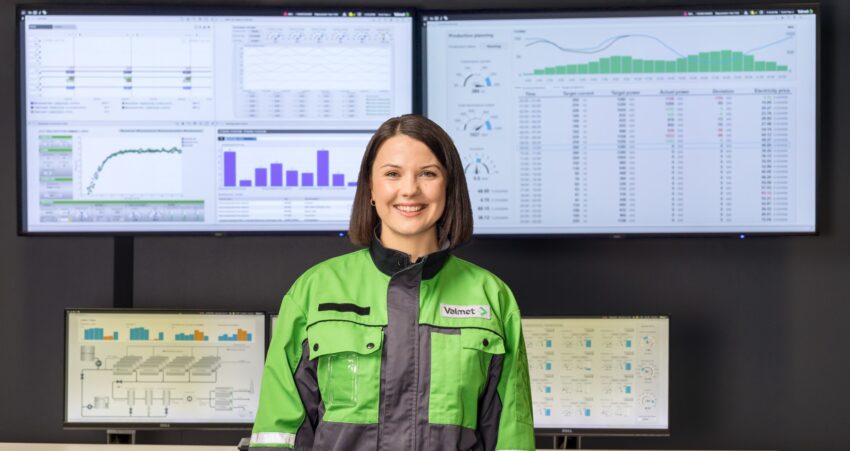
In industrial control environments, the User Experience, or UX, when interacting with a Distributed Control System (DCS), impacts how effectively and efficiently operators monitor and control industrial processes.
It also plays a critical role in safety. Poor UX can lead to misinterpretation of data, delayed responses, alarm fatigue, and operational mistakes, while good UX contributes to faster decision-making, reduced training time, improved operator confidence, and more stable plant operation.
“Today, UX design is no longer a ‘nice to have’ in safety critical process industries. Instead, it plays an important role in how operators control the process, improve situational awareness, and make the right decisions under pressure,” says Anna Sydänmaa, Business Manager at Valmet, a global technology leader in serving process industries.
A well-designed user experience helps operators maintain situational awareness by ensuring critical information is available when it matters most. By reducing unnecessary mental effort, it enables faster, more confident decisions and lowers the chance of mistakes.
The UX also considers how efficiently operators can carry out everyday tasks such as reviewing trends, acknowledging alarms, adjusting setpoints, and performing diagnostics, along with how rapidly they can understand abnormal conditions and take appropriate action.
At Valmet, UX design is incorporated into the development of its leading Distributed Control Systems (DCS). As part of a ground-up approach to designing its new web-based DCS, DNAe, the Valmet design team placed a strong emphasis on improving the system’s user experience (UX).
At its core, a well-designed UX enables operators to achieve situational awareness at a glance.
Situational awareness describes an operator’s capacity to rapidly comprehend system conditions, identify what requires attention, and anticipate upcoming developments. To support this, the interface must present information in a clear and intuitive manner, allowing operators to immediately understand the current state of the process, recognize abnormal behavior, and make sound decisions without the need to hunt for information or mentally piece together essential data.
In the case of alarms, for example, maintaining situational awareness requires deprioritizing non-critical information and ensuring that key information is placed where operators can easily see it and act upon it.
In an industrial control room, thousands of alarms can appear in seconds. Operators then have only a few seconds to find the real issue and take corrective action. In these high-risk environments, where chemicals and flammable materials are part of daily operations, a well-designed UX can make the difference between a near-miss and a major incident.
Ultimately, safety in process industries is influenced not only by technology and procedures, but by how effectively people are able to perceive, interpret, and act on critical information.
By organizing information in a manner that reflects real operating conditions, effective UX design helps stop errors before they escalate and makes a direct contribution to safer, more reliable process operations.
For more information about Valmet’s process automation systems, please visit http://www.valmet.com.