
Containerized battery energy storage systems (BESS) have expanded rapidly in North America as utilities, businesses, and communities integrate batteries for grid stability, backup power, renewable energy integration, microgrid support, and hybrid energy systems.
This widespread adoption is one reason safety standards such as NFPA 855 have become more significant, as regulators and industry stakeholders seek consistent guidelines for safely installing and operating the expanding number of battery energy storage systems.
The NFPA 855 standard exists because large battery installations introduce unique hazards, particularly with lithium-ion batteries, including thermal runaway, flammable gas generation, and potential fire propagation between battery modules or containers.
Hydrogen Accumulation
According to Geof Brazier, Managing Director of BS&B Safety Systems Explosion Protection Division, in the most recent 2026 edition of NFPA 855, several new requirements were introduced related to battery system hazards and protection strategies, including expanded hazard-mitigation analysis, additional testing expectations, and stronger provisions related to fire and explosion risk management in large battery installations.
In BESS installations that use lithium-ion batteries, hydrogen and other combustible gases can be generated during thermal runaway or internal battery damage. When lithium-ion cells overheat or fail, chemical decomposition of the electrolyte and other cell components can produce a mixture of gases that may include hydrogen, carbon monoxide, methane, and other flammable compounds.
The danger arises when hydrogen or other flammable gases accumulate in an enclosed space and are then ignited by electrical equipment, static discharge, or other ignition sources.
When the percentage of hydrogen in the air is around 20%, detonation events can generate powerful shock waves that travel faster than the speed of sound.
“When you get into the higher percentages, you are dealing with explosions that can transition to an unprotectable detonation, so it is important to do the utmost to reduce the level of hydrogen accumulation in the container so the conditions for an explosion do not arise,” says Brazier.
The resulting deflagration or explosion may not only damage the container but may propagate fire driven overheating to adjacent BESS modules.
Because of these risks, Brazier says modern BESS designs emphasize early detection and layered protection strategies. These include monitoring battery temperature and voltage to detect failures early, detecting flammable gases before they reach hazardous concentrations, and providing controlled ventilation or explosion relief to prevent pressure buildup.
BS&B Safety Systems’ VSP Actuated Ventilation System is an NFPA 69 explosion prevention device designed to protect BESS enclosures by actively releasing combustible hydrogen and other accumulated gases before an explosive concentration arises.
Sensors continuously monitor combustible gas concentrations inside the enclosure. When elevated gas levels are detected, an actuator opens the vent flap to safely discharge the gases. Once concentrations return to acceptable levels, the actuator closes the flap, and normal operating conditions are restored. This automated cycle repeats as needed whenever elevated gas levels are detected, providing continuous protection for the enclosure.
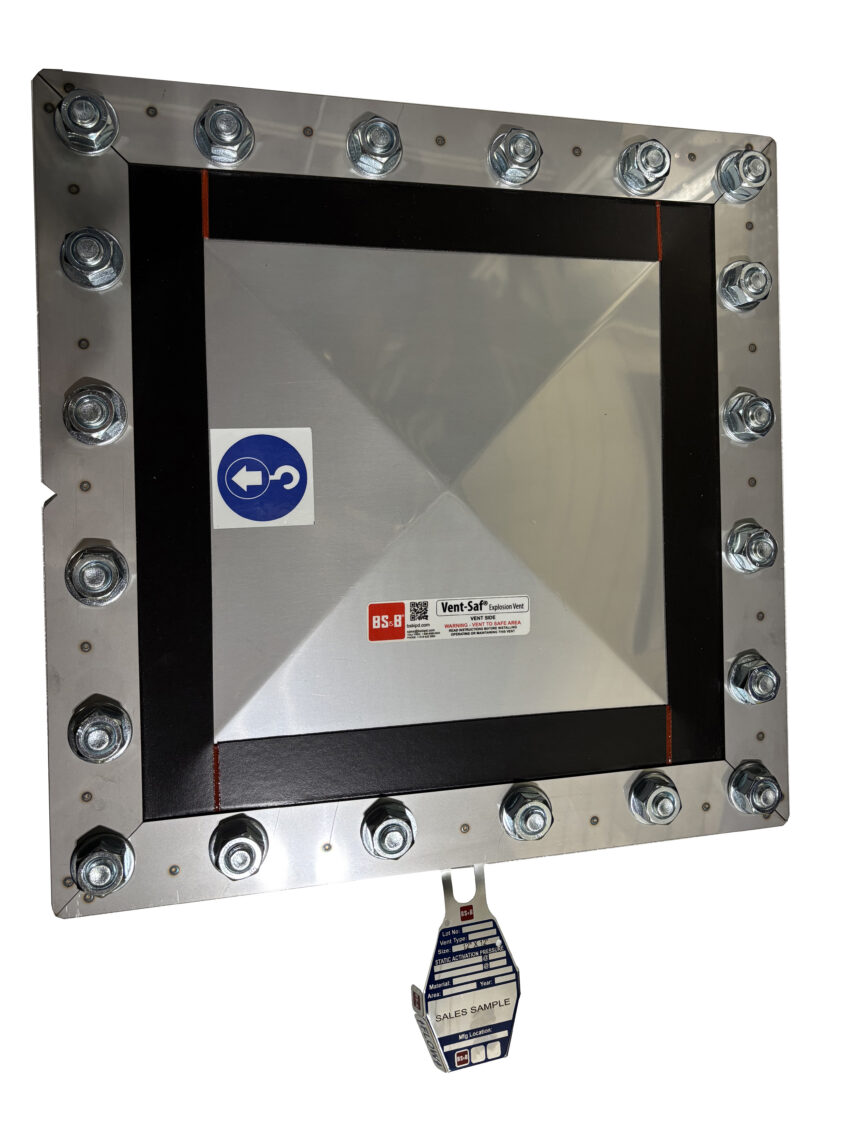
Containerized BESS are also increasingly fitted with explosion vents to control the pressure spikes and direct flame and gas when a thermal-runaway event causes a flammable atmosphere to ignite and a low concentration of combustible gas results in a deflagration.
Brazier says BS&B specifically designed its BESS-Saf™ as a family of explosion and pressure relief vents with BESS enclosure dynamics in mind. The vents support controlled pressure relief to help mitigate explosion risk resulting from thermal runaway and gas generation.
Flame-Free versions incorporate a flame arrester rated for hydrogen and other gas deflagration conditions with an explosion vent. This combination provides a reliable layer of protection for enclosures exposed to deflagration and overpressure risks.
For more information, contact BS&B Safety Systems at 7455 East 46th Street, Tulsa, OK 74145-6379, call: (918) 622-5950, e-mail: sales@bsbsystems.com or visit https://bsbsystems.com/.