
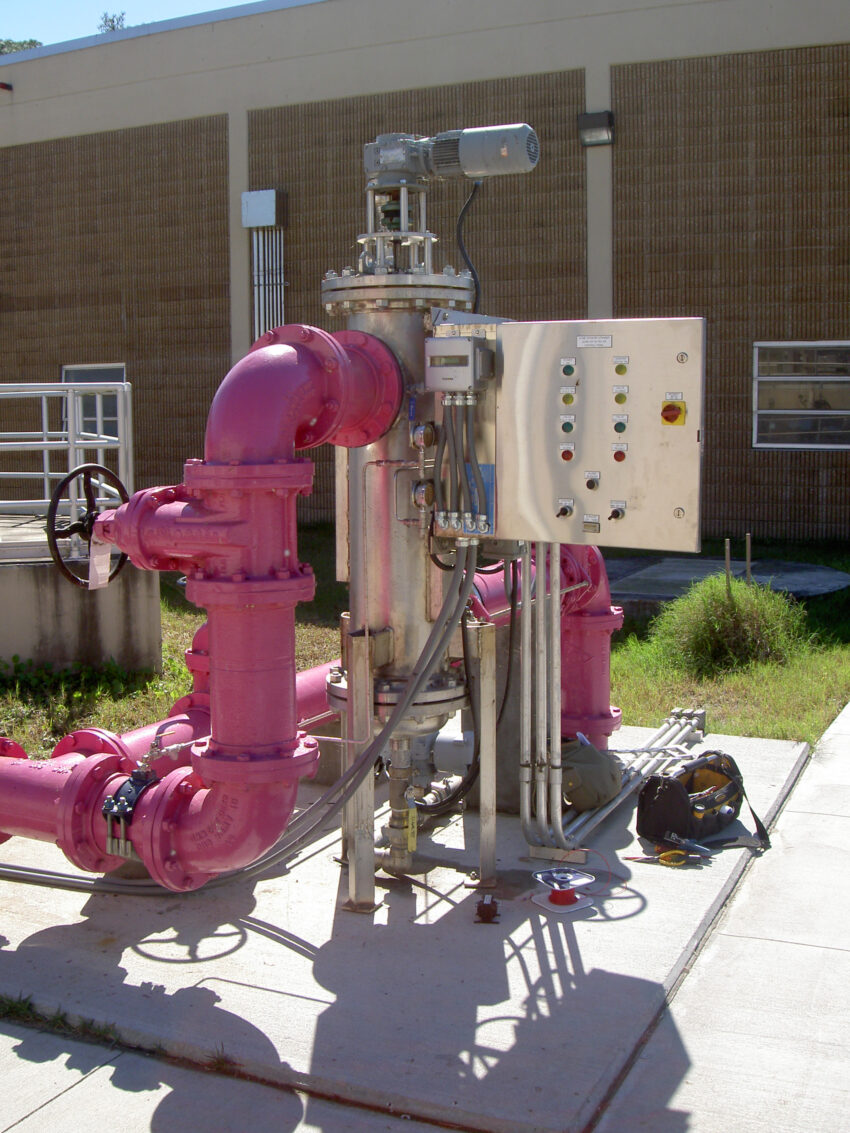
For industrial plant managers, automatic scraper strainers are among the closest solutions to a true “set-and-forget” system, effectively removing both large and fine suspended solids from industrial water, cooling tower water, liquids, and slurries.
The basic design represents one of the most efficient and cost-effective industrial self-cleaning strainers available. The motorized unit is engineered for minimal maintenance and operator involvement and can remove solids as small as 75 microns.
However, incorporating minor customizations or application-specific modifications can further optimize the automatic scraper strainer’s performance, according to Robert Presser, President of Acme Engineering Products, Inc., a North American manufacturer of industrial self-cleaning strainers.
Presser recommends the following design refinements that can improve overall effectiveness and operational results of scraper strainers for specific applications.
Choose the Screen Best Suited to the Application
Scraper strainers are available in various screen constructions, each engineered to address different process requirements and operating conditions.
Reverse-formed wedge wire screens are the standard configuration and are widely used due to their mechanical strength, long service life, and resistance to deformation under high differential pressures.
For processes that require finer filtration or more precise particle retention, multilayer sintered metal mesh screens are the preferred option.
In applications handling fibrous or stringy materials—such as those commonly encountered in the pulp and paper industry—perforated screens with round holes offer superior performance.
Affordable Solutions for More Effective Solids Removal
Scraper strainers allow the solids to accumulate at the bottom of the vessel, where the blowdown valve will open periodically to clear them out.
If additional pressure is required to clean the screen, however, an inexpensive trash pump can be added to the blowdown line to assist in removing the solids, debris, and sediment that collect in the strainer sump.
Alternatively, the sump can be replaced by a cylinder bracketed by two gate valves that open and close as needed to remove the solids waste.
Add a Macerator to Break Up Large Solids
For applications with high solids loading that are prone to clogging, a macerator can be installed upstream of the automated scraper strainer.
“The design effectively delivers a one-two punch, with the macerator breaking down large solids into smaller fragments and the automated scraper strainer efficiently filtering out the debris along with the tiny particles,” explains Presser.
Specify Fiber-Reinforced Plastic (FRP) Construction
When the chemical properties and temperature of the process fluid raise concerns about material compatibility, automated scraper strainers are available in other materials such as Monel, D2205, SD2507, and even Fiber-Reinforced Plastic (FRP).
Presser points out that FRP can be used for external strainer construction, including for pressure vessel applications up to 300 PSI. The internal mechanism is still manufactured with super duplex or similar steels. With this approach, manufacturers can reduce costs by approximately 50 percent or more while maintaining required performance standards.
For more info, visit Acme Engineering Prod. Inc. at acmeprod.com; phone Philippe Ellison, Project Manager at: +1-518-236-5659; email phil@acmeprod.com; mail Acme at Trimex Building, Route 11, POB 460 PMB 10, Mooers, New York 12958. In Canada phone: +1-514-342-5656; mail them at 5540 Rue Paré, Mont-Royal, QC H4P 2M1.