
Consulting engineers designing systems for industries like wastewater treatment, power generation, and food or chemical processing must specify strainers that reliably remove solids from liquids. Traditionally, backwash filters and manual basket strainers have been the go-to options—but these often fall short in demanding, high-debris applications.
Manual basket strainers require frequent hands-on cleaning, increasing labor and downtime. Duplex designs offer redundancy but add complexity and still depend on manual intervention. Backwash strainers, while automatic, rely heavily on consistent pressure and flow. They are ineffective below 30 PSI and struggle with large or sticky solids.
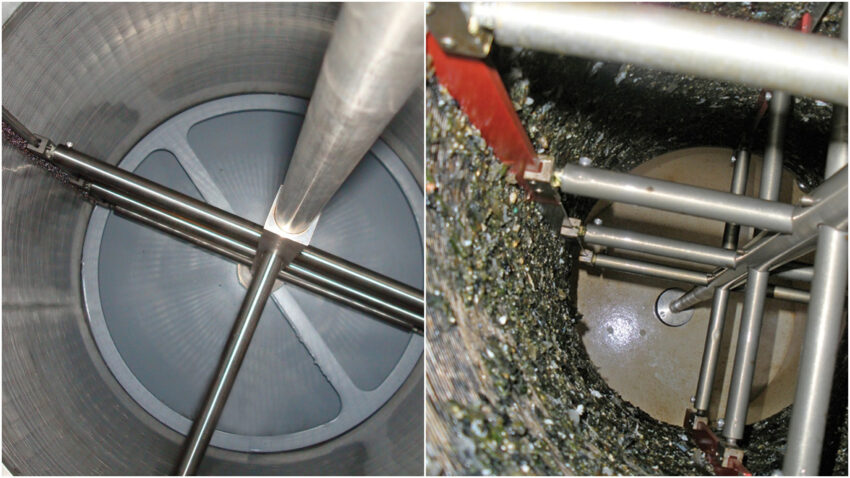
Automatic scraper strainers offer a robust alternative. Using motor-driven brushes or blades in direct contact with the screen, they provide reliable, programmable self-cleaning without auxiliary piping or external water sources. They perform well under variable conditions and are effective even with fibrous or large solids. Solids settle at the bottom and are expelled via a timed blowdown valve, keeping liquid loss below 1%.
Material options like Monel, D2205, and FRP extend durability in corrosive or erosive environments. Consulting engineers can size these units based on flow rate, solid type, and load concentration.
For applications with high solids loading that are prone to clogging, a macerator can be installed upstream of the automated scraper strainer to break down large solids into smaller fragments. This combination of proven technologies is already in use for some of the most demanding and debris-laden straining applications.
Although scraper strainers have a mid-level cost, they replace multiple manual units and reduce infrastructure needs. Their maintenance profile is minimal, with low-cost wear parts like brushes and blades. Over time, they offer balanced or even reduced lifecycle costs compared to backwash or basket systems.
As awareness grows, consulting engineers are increasingly adopting scraper technology to meet modern filtration demands with fewer compromises.
For more info, visit Acme Engineering Prod. Inc. at acmeprod.com.