
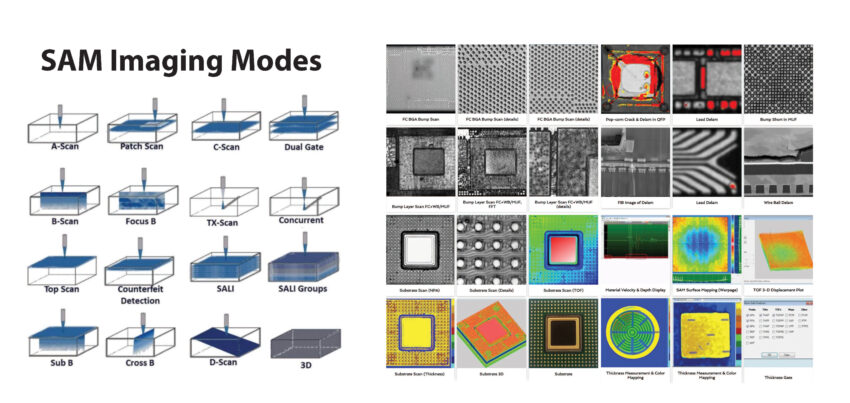
Scanning Acoustic Microscopy (SAM) has become a critical non-destructive testing method for confirming high reliability in aerospace and defense applications by detecting hidden flaws and validating material integrity.
In aerospace and defense, the electronics and materials incorporated into satellites, aircraft, and defense platforms are expected to function in conditions that push the limits of materials science and engineering design. Unlike consumer-grade devices, which may tolerate minor faults, aerospace devices cannot afford a single unexpected failure, since mission success and human safety depend on consistent performance.
This principle forms the foundation of a high-reliability approach – an engineering philosophy focused on designing and manufacturing systems, components, and processes that must perform dependably under mission-critical or extreme conditions.
Achieving high reliability in aerospace and defense requires the deliberate selection of specialized materials coupled with durability-focused design practices to ensure structural and electrical integrity when subjected to extreme stress.
In addition, hidden defects such as microscopic voids in solder joints, delamination within composite structures, or cracks in semiconductor packages may remain undetected during fabrication. When subjected to the extremes of vibration, thermal cycling, or radiation, such flaws can compromise the entire system.
Testing is therefore an essential element of high reliability.
This is where nondestructive evaluation methods become indispensable. Ultrasonic non-destructive testing (NDT) has long served as a core inspection method within the aerospace and defense sectors. This technique employs high-frequency sound waves to detect even the smallest defects in components or assemblies without inflicting any damage.
Scanning Acoustic Microscopy (SAM) is a specialized ultrasonic method that uses much higher frequencies, usually between 50 megahertz and several gigahertz.
“SAM extends defect detection to an entirely new scale: scans that were once limited to 500-micron flaws can now reach down to 50 microns, exposing imperfections that previously went undetected,” says Hari Polu, President of PVA TePla OKOS, a Virginia-based manufacturer of SAM and industrial ultrasonic non-destructive (UT-NDT) systems.
Unlike conventional ultrasonic NDT, which is used to detect flaws in large components with complex shapes, SAM is designed to generate highly detailed acoustic images of microstructures and stacked flat layers.
SAM Applications in Electronics and Metals
In the semiconductor and electronics industries, SAM equipment has evolved and is now being used to detect subsurface flaws, dis-bonds, cracks, and other irregularities in these types of materials that constitute the “packaging” of semiconductor components.
Beyond semiconductor components, today’s electronics products contain various specialty metals, alloys, plastics, and glass components.
Today, the same rigor of quality testing and failure analysis is also being applied to validate the integrity of diffusion bonded metals. To ensure the quality of the interface, materials engineers must analyze samples to validate the quality of the bond.
For more information, contact PVA TePla OKOS at ndt@pvatepla.com or visit www.pvatepla-okos.com. OKOS is a wholly owned subsidiary of PVA TePla AG, Germany.